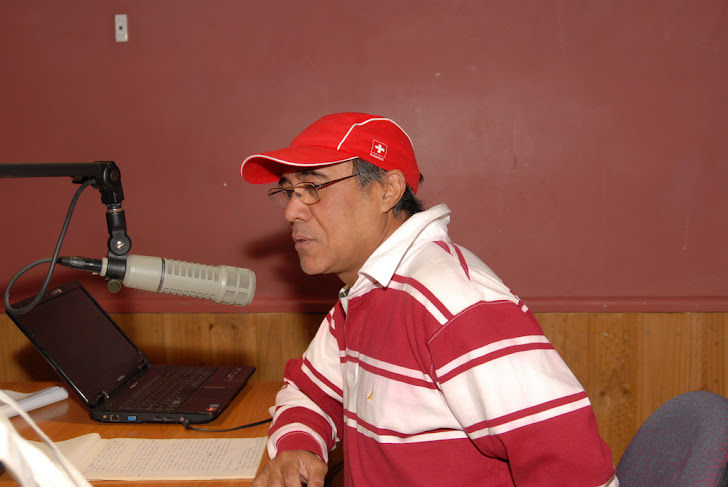
George at Studio 2GLF 89.3 fm

George at Studio 2GLF 89.3 fm
Broadcasting Emission Kontak

Wednesday, 13 February 2013

Sex, lies and corruption in paradise.

Navin Ramgoolam, the Prime Minister of Mauritius, a disgrace.
by GDL

Qui est  Navin Ramgoolam, sinon  le fils de Sir S. Ramgoolam qui a vendu les chagos  et les chagosiens pour obtenir l’independence de l'ile Maurice. Une independence que SSR et ses ministres corrompus n’ont pu gerer mennant le pays a la branqroute  jusqu'a 1982 quand le peuple de Maurice les envoya dans karo kann.
Navin Ramgoolam came to politics by accident.  Il n'a rien de commun avec les anciens grands leaders du Parti Travailliste comme Cure, Anquetil ou Rozemont. His father once said not to let this guy get into politics. Why ? Simply because his father knew Navin more than anyone else. He might have known his strenghts but he definitely knew his weaknesses.
The words of SSR  are today confirmed by the way his son is managing the affairs of the country. Navin Ramgoolam is reknown to be lazy, hates hard work and surrounds himself with cronies and corrupt people . It is said that he cannot take a decision, even in the most pressing case and leaves files piling on his desks.
On the other hand he has a liking for women, which he admitted (bann madame content mwa), for partying (like Macarena and Roches Noires), likes to drive expensive cars (like Aston Martin)  racing at night on the freeway. He wears expensive watches, like Rolex (he said he has more than one !!). He would  go to London frequently, freeing the first class for him alone (guess why ?). Last but not least, he speaks nonsense most of the time.
The recent episodes of his association with Gooljary and Soornack, have uncovered his dubious habits. Apparently his good friend, Gooljary was only his "gardien campment" who   suddenly became a multimillionaire. It is not strange that the one who controls who comes in and out of the bungalow or facilitates the secret entries to the bungalow to be close to his master. But the reward for keeping these secrets and planing the nights outs of Navin, comes with a high price. that of benefiting from all priviledges and whose transactions and commerce flourish with the help of high profile politicians.
A for Mrs Soornack, the Mauritan press gave a close and detailed account of how she met the Prime Minister. Since then  she has been travelling extensively, divorced  her husband, moved to the most expensive suburb in Mauritius and now a very rich businesswomen. The businesse have links with government and parastatal bodies, whose permits have been granted through political backing.

Navin Ramgoolam has no legacy, he only plays on the emotion of Hindus by reminding them of his deceased father. His governments have done nothing remarkable if not getting the country in a worse state with a lagging economy, high cost of living and corruptions at all levels.
The man is a disgrace for the country and many people with a bit of intellect are holding their heads in their hands in shame. Mauritians cannot reconcile how this man can be so devoid of morality and only blinded by power and cronyism.
He is a real shame and the guy must go. His time is definitely up, he should go now.
GDL.


Friday, 1 February 2013

Welcome to 2013, election year in Australia

2013 is election year in Australia.
This week the Prime Minister Julia Gillard, announced that the general elections
will be held on the 14 September 2013.
This is the first time in Australian politics that the date of the elections is officially
known eight months in advance.
What was the aim or strategy of the PM to make the date known so early is
the centre of many debates. However, she said that this was done to avoid any speculation
and to give business an assurance so that they can make up their plans.
By the same token, Julia Gillard was aiming at putting pressure on the opposition to
release their policies and the costings.
While the leader of the opposition, Tony Abbott, welcomed the news, he does not intend
to release the whole of the coalition's policies and said that he will wait for the government
to release theirs first. Here we go again...
The opposition has been leading in the polls since the last elections by a wide margin. However,
since the end of last year the Labor government has been closing the gap. The carbon tax
implemented in July 2012, does not seem to have the devastating effect that the opposition
was expecting. But the Graig Thompson and Peter Slipper sagas and their being charged
for criminal offence haves not helped the government. The boat people issue is not helping          them neither. Cost of living has also gone up but the lower income earners have received compensations.
The government is betting on the good economic condition the country is now,
in as compared to the other OECD countries.  Pensioners are happy and the unemployment rate          remains low.
While many pundits were forcasting that the minority government would not last a full term,
they have all been proved wrong. This was possible due to the skillful negotioation of the PM
with the independents and the Greens. She also manged to tackle Kevin Rudd, and the leadership
contest twice.
While we are still far from September 14, Australia is already in a campaign mood.
GDL.

Le duel entre Julia Gillard et Tony Abbott s'annonce acharne.
la date des elections fixee au 14 Septembre 2013.
La course largee....

Politics:
A Maurice, le declin et la fin du regne de Navin Ramgoolam
a commence avec les elections villageoises et municipales.
Bizin are sa kalite majakaro et abus de pouvoir de Navin Ramgoolam.
Navin Ramgoolam indigne d'etre un PM.
Il n'est pas serieux et aime plutot s'amuser.
Sa vie personelle est tintee de scandales.
Ses aventures rocambolesques noctures sont maintenant exposees
le public en sait plus qu'il ne le croit.
Bizin botte son derriere et envoy li dan karo kann.

All the news and analysis regarding the campaign and the elections,
tune in to Emission Kontak Dimanche on 89.3 fm
Live on the internet at www.893fm.com.au
Keep listening to Radio Kontak on the net as well.
Click on the link below
http://station.voscast.com/5000bc537c8f9/
The best music ....so entertaining.
Les plus belles chansons francaises et anglaises,
des chansons nostalgiques et des chansons souvenirs.
Cheers
GDL

Wednesday, 9 January 2013

Ethics and the media

From Aristotle to new media by GDL
Aristotle and ethics

Aristotle was a Greek philosopher who built his ethical theory from the previous writings and discourses of Plato and Socrates. According to Aristotle, we study ethics in order to improve our lives, and therefore the principal concern is the nature of human well-being. Aristotle regarded the ethical virtues like justice, courage, temperance as complex rational, emotional and social skills. According to Aristotle, what we need, in order to live well, is a proper appreciation of the way in which such goods as friendship, pleasure, virtue, honour and wealth fit together as a whole. In his wisdom, Aristotle also argued that through practice, those deliberative, emotional, and social skills enable us to put our general understanding of well-being into practice in ways that are suitable to each occasion. He places the bar quite high in defining his search for the good as the search for the highest good, which according to him has three characteristics, it is desirable for itself, it is not desirable for the sake of some other good, and all other goods are desirable for its sake (Aristotle Ethics, 2001)
Ethics is generally concerned with what is right and wrong, how people should live their lives and what to do when they lack specific guidance from laws and morals. (Harrison 2011 page 124).  According to Harrison, truth is the essence of ethics, but truth can have a limited scope where at times only part of the truth is divulged. He added,
When people are referring to the truth, they are really referring to an account of it despite believing they are being accurate and factually correct. But facts can be subjective and value laded” (Harrison 2011 page 122)
Gower, (2006) for his part explained that from an ethical standpoint, being truthful means not lying and from a legal standpoint, it means that the information can be verified and is not misleading. (Gower 2006 cited in Harrison page 123).
Bowen (2007), states that ethics normally have in common the element of requiring some form of systematic analysis, distinguishing right from wrong and determining the nature of what should be valued. Ethics, he said, includes values such as honesty, openness, loyalty, fair-mindedness, respect, integrity and forthright communication. (Bowen 2007 cited in Harrison page 124).
There are other branches/theories of Ethics: the theological (utilitarian or consequentialism) which focuses on the consequences of what action will be best for most people. They should consider all alternatives and the consequence of their actions. (Grunnig and White 1992, cited in Harrison 2011 page 25).                                The deontological moral philosophy is commonly known as Kantianism, developed by the famous German philosopher Emmanuel Kant. He argued that to act in the morally right way, people must act from duty. He added that it is not the consequences of actions that make them right or wrong but the motives of the person who carries out the action. Kant‘s deontological ethics is about rules and duties, or about the humanitarian approach of moral obligation. (Kant 1964, cited in Harrison 2011 page 125).                                                                                                                            Other branches of ethics worth mentioning are, situational also called “ethical relativism” and dialogical ethics where dialogue is considered to be inherently ethical.
 
Ethics in the media business

The question of ethical behaviour in the media and the ethical dilemmas confronting journalists, have been subject of long and passionate debates. The conflict has also been around what is legal is not necessarily moral and what is unethical is not necessary illegal. Pearson and Pollen (2011) agree that everyday of their working life journalists have to make decisions that could have legal and ethical implications. They, however, stress that it is imperative for journalists to have a sound knowledge of the legal and ethical considerations that apply to their occupation. (Pearson and Polden 2011, page 4). The ethical dilemma confronting the media often rests on what is understood or perceived as freedom of speech and the press. The limits or boundaries are very often undefined or blurred or again confuse some students. Freedom of expression is allowed in many democracies, particularly western democracies where liberties are often taken for granted. 
Poet like John Milton and philosopher John Locke are great advocates of the freedom of expression and their ideas found their way into the wording of the US constitution and the Bill of Rights and supported by Thomas Jefferson. If the First Amendment clearly protects freedom of the press, nevertheless their behaviour is not unrestricted. (Pearson and Polden 2011, page 28). Even if the freedom of the press is not enshrined in the Australian constitution, in recent years the High Court of Australia has handed down a series of decisions recognising an implied freedom to communicate in matters of government. ( Pearson and Polden 2011, page 32).
Freedom of the press does not preclude journalists of their duty to inform accurately, fairly, to educate the audience and be balanced and truthful in the first place. However going beyond these ethics can also have legal implications as mentioned by Sir William Blackmore in his commentaries on the law of England:
“ …Every freeman has an undoubted right to lay what sentiments he pleases before the public ; to forbid this is to destroy the freedom of the press: but if he publishes what is improper, mischievous or illegal he must take the  consequences of his own temerity.” (Pearson and Polden 2011 page 27).

Freedom of the press has its boundaries, in other words, that freedom does not allow the media to intrude into people’s privacy even if they are public figures. Even if the law in some countries now protects the rights of the individual to privacy, it does however remain an unethical consideration for journalists, or paparazzi, to violate or invade any person’s privacy, through lack of respect for the individual. From an ethical perspective, as advocated by Aristotle and other modern philosopher like Kant, respect lies at the heart of behaviour.
Throughout the years, it is noticed that the same respect for the individual’s right to privacy has not been respected. The Princess Diana’s case is a landmark which even caused her death. But this practice has not stopped. The media  continued to do it in the case of Prince Charles, Prince William and Price Harry and some celebrities, just to name a few. In some sections of the media, the legal, and even ethical, considerations look to be overtaken by the need to satisfy the audience and readership. The recent backlash faced by the phone tapping by journalists of the News of the World, has overtly exposed the unethical, if not illegal, behaviour of journalists.                                                                                                                                                      The other argument is, whether freedom of the press justifies that information should be published to the extent of bringing an individual into disrepute. Despite the laws now sanction publication of defamatory nature on an individual, there are still many cases brought to courts everyday. Here again it seems that instead of abiding to ethical and legal boundaries, some in the media take calculated risks to go ahead by weighting the probability of the individual suing them against the income that these “news” will generate. This is also unethical in nature.  This business practice meets Noam Chomsky’s argument that that media focus on maintaining constraints on dialogue to promote the interest of corporations or that media are drawn into synergetic association with influential sources of information by economic interest. (Chomsky 1997).
Freedom of the press does not imply that journalists should abuse of this privilege and forgo the ethical consideration. As Bowen argues, at the end it is a question of conscience which reinforces the need to integrity, fairness and respect. (Bowen 2007 cited in Harrison page 124)

 The advent of Social media and bloggers

According to O’Keefe and Parson (from the council of communication and media), social media is:

Any Web site that allows social interaction is considered a social media site, including social networking sites such as Facebook,, MySpace, and Twitter; gaming sites and virtual worlds such as Club Penguin, Second Life, and the Sims; video sites such as YouTube; and blogs. Such sites offer today's youth a portal for entertainment and communication and have grown exponentially in recent years.”

The advent of Social media and bloggers has added new dimensions to the media sphere and environment. If they are mainly used as social networking, they are also carriers of news and more, sources of news for many. Social media has the advantage of being interactive and user generated content. Post a note on Twitter or Facebook and soon there is a flood or reactions, responses and comments.
Blogs are also user generated and they reflect mainly the personal opinion and analysis of the blogger. Some journalists, in Australia like Andrew Bolt or Piers Akeman or Miranda Devine are very much into blogging. Blogs allow the writer to expose his or her personal views which can be bias and subjective.
To this day, there are no laws that regulate new and social media as long as they are online (new media). But again this should not allow the blogger to defame or intrude an individual’s privacy or to tweet around an individual private dealings. This is an opportunity, in the absence of the legal regulations to reinforce the ethical considerations.

Conclusion
The media and journalists have the duty to inform, educate and entertain. The public rely on the media to be informed accurately and fairly. The fourth power conferred to the media is quite meaningful. The media is indeed a powerful tool in conditioning our minds and thoughts. The media can influence decision makers, and highlight the weakness of some business practices for example. They can hold the government of the day to account, denounce corruption, and be a reflection of the citizen’s views and concern.  The media however should play this role within the boundaries of the law of the land but most of all in an ethical way, underlying fairness, loyalty and respect for the same audience that they are called to serve. It is gratifying to see that many in the media have consistently upheld a positive image by always being ethical. They are the ones, who at the end, commands respect.
The bottom line is that, journalists whether in print, broadcast and new media, still have an ethical obligation to be fair in all circumstances for the good and well being of all concerned. Aristotles' ethics are still relevant today and maybe more than ever before in this postmodern information era.

Sources/ Reference:
Trends of Anarchy and Hierarchy, Comparing the cultural repercussions of Print and Digital Media, http://www.cyberartsweb.org/cpace/infotech/asg/ag5.html, accessed on 27/10/2012.
Stanford Encyclopaedia of Philosophy – Aristotle ethics, 2001, 2010, http://plato.stanford.edu/entries/aristotle-ethics/ accessed on 27/10/2012.
Emmanuel Kant 1964, Groundwork of the Metaphysic of Morals, Harper and Row Publishers.
Code of Deontology, Luxembourg, adopted by the Press Council in 2004 http://ethicnet.uta.fi/luxembourg/code_of_deontology accessed on 27/10/2012
MEAA code of ethics:  appendix 1, Pearson and Polden 2011, South Wind Productions, Singapore
Kim Harrison 2011, Strategic Public Relations, a practical guide to success, Pulgrave Macmillan.
Mark Pearson and Mark Polden, 2011 4th Edition, The journalist Guide to media law, South Winds Productions, Singapore.
What is social media ?
Noam Chomsky What make mainstream media mainstream, 1977 http://www.chomsky.info/articles/199710--.htm Accessed on 13 Nov 2012
Noam Chomsky on Media, Politics and Actions by Aaron Stark, December 1998, http://www.chomsky.info/articles/199710--.htm accessed on 13 Nov 2012.
                                       

Sunday, 23 December 2012

MERRY CHRISTMAS TO YOU ALL


I wish you a Merry Christmas and a
Happy New Year 2013.
www.lecourriercreole.com

Keep listening to Radio Kontak on the net.
Click on the link below
http://station.voscast.com/5000bc537c8f9/
 The best music ....so entertaining.
Les plus belles chansons francaises et anglaises,
des chansons nostalgiques et des chansons souvenirs.

Politics:
A Maurice, le declin et la fin du regne de Navin Ramgoolam
a commence avec les elections villageoises et municipales.
Bizin are sa kalite majakaro et abus de pouvoir de Navin Ramgoolam.
Navin Ramgoolam indigne d'etre un PM.
Il n'est pas serieux et aime plutot s'amuser.
Sa vie personelle est tintee de scandales.
Ses aventures rocambolesques noctures sont maintenant exposees
le public en sait plus qu'il ne le croit.
Bizin botte son derriere et envoy li dan karo kann.

2013 is election year in Australia.
Le duel entre Julia Gillard et Tony Abbott s'annonce acharne.
la date des elections fixee au 14 Septembre 2013.
La course largee....

All the news and analysis regarding the campaign and the elections,
tune in to Emission Kontak Dimanche on 89.3 fm
Live on the internet at www.893fm.com.au

Cheers
GDL

Thursday, 13 December 2012

Council Elections in Mauritius

Elections Municipales a Maurice par GDL

The recent council elections in Mauritius saw  the opposition winning three out of the five councils.
In can be said, three and a half because in Curepipe, the opposition did not win nor did loose. Each of the major blocks won seven seats each. One independent from the MMSD will decide who will administer the town for the next five years.

It was a lost for the government as they have been too long in control of the towns. Instead of having the elections after the five-year term, they stayed in power for another two years. This postponement of the elections was purely a tactic from the central government allowing the councillors to stay in their positions and enjoyed. Unfortunately, they did not use these additional two years towards a more responsible approach but kept indulging in inner bickering, routs and corrupt behaviours.
It looks as if the sound and effective administration of the towns and the welfare of the city dwellers was not their priority.

The leader of the Government and the ruling coalition realising that their councillors have not been up to scratch, put a new team to face the elections. The Prime Minster, Navin Ramgoolam, invested in the campaigns and even danced the sega in the streets to attract media attention. He also got mad when the national television did not show him campaigning at Cite Atlee in Curepipe.

According to an article by Anil Gayan which appeared in L'Express on 11th December 2012, Navin Ramgoolam played the division game during the campaign. He has a type of rhetoric to the Muslims of Plaine Verte and used another language to the Hindus of Palma and La Source. According to the author, this was an attempt at balkanising Mauritius and dividing the electorate on community grounds. Anil Gayan expressed his disgust at such a tactic by the Prime Minister of the country. Many times Navin forget that he is a statesperson and feel more comfortable in the politician role. This is not only a weakness on his part but a shortcoming. He lacks the stature of a PM.

However, this is no strange or new; Navin Ramgoolam  won the past elections while playing on the emotions of the Hindus in rural areas telling them not to vote Paul Berenger as he is not an Hindu. This strategy of divide and rule has up to now worked in his favour. But not this time it seems.

This time he  tried to sow division between the Muslims and the Hindus and targeted Aneerood Jughnuth as the enemy of Muslims. He vehemently attacked SAJ seein him as a direct competitor,  more so because the Jughnuths  are of the same cast as him, Vaish. The results in Sodnac in Quatre Bornes show that there is a change of voting patters of the Hindus. They do not overwhelmingly support Navin Ramgoolam and his corrupt government.

While the victory was overwhelming in Beau Bassin/ Rose Hill, the results were tighter  in Port Louis and Quatre Bornes but a win is a win. It was a psychological boost for the opposition which will give hope to their supporters that the next general elections are winnable.

No matter what happened in Curepipe, the facts are, the government has lost control over the town councils and apparently even in the village councils. The voters sanctioned the government councillors for their lack of dignity, for their abuse of power, the maladministration of the towns and their manze, bwar, amuse, voyager attitudes.

The writings are on the walls for the government alliance. Having all the ministers on the campaign trail,( some even to the extent of bribing the electorate with macaroni packets), was toxic for the government as they are all perceived to be corrupt and incompetent. They repulse the people more than they attract them. There was also the broyani affair which the people of Quatres Bornes were waiting to sanction Nita Deerplasing,  the campaign manager in the town.

The Remake 2000, through these results received the blessing of the people of the towns ( and also of the villages ). But the tandem SAJ and PB need to work harder and not take for granted that the wave is bulding up and the tsunami will strike in 2015.


Sunday, 9 December 2012

George's Blog: The lucky country by GDL

George's Blog: The lucky country by GDL: In Australia, we do ot seem to be afraid of uncertainty and not scared of what tomorrow will be. We take forgranted that live in the world...

The lucky country by GDL


In Australia, we do ot seem to be afraid of uncertainty and not scared of what tomorrow will be. We take forgranted that we live in the land of plenty, in the lucky country and that we are  allright. How many times have we not heard, said to someone in trouble, " You'll be allright mate".

In Australia, we have seen boom and bust, we have seen recession and growth, we have seen changes from left wing to right wing governments, we have seen natural catastrophes like flood, fire, cyclones, even earthquakes, but we are still going.

Australia is in fact the lucky country. Many migrants who were living in abject poverty, living on the edge and starving in their thirdworld contries, or again in refugee camps  where tomorrow culd not even be compemplated, have come to this country and now living like a decent human being.
Some have come from wartorn countries to find peace and harmony in Australia, and sleeping tight at night. Others have fled persecutions and discrimnation to find their self-esteem restored here.
Others without any qualifications whatsoever, or could not even say a word of english, have found their way in life here. Not  only they are living very comfrotably, but have had children who are today graduades and professionals.

Australia is a first world  country by living standard and its high GDP per capita.  The country has a rich deposit of mineral resources, has vast arabe land and pastures, and the fundamentals of its economy are strong. We have 10 percent of the very rich, a very big middle class and a very small percentage of  proletariat. Poverty is a relative term in Australia. Someone will  find that he is poor  only by comparison. A relatively poor person in Australia, will always be able to cut his/her clothes according to the cloth. There is always a shop where a poor person can find what he/she needs, and/or find ways to have a roof over his/her head.

Australia is a generous welfare state, with an effective social security system including dole for the unemployed, invalidity benefits, new start allowance, Austudy for the students, and a means-tested old aged pension, just to name a few.

Like most of the developed world and economies, Australia has its social problems. The level of mental health is very high, 285 people are diagnosed with diabetes everyday, there is a high rate of death from cancer and alcohol related diseases. The unemployment rate, if it is only around five percent, means that close to 400,000 people are living on the dole and not able to envisage a clear future. The youth suicide is high and drugs is on the rise among the youth.
There is a proliferation of nursing home because of our ageing population, and that the baby boomers have now reached retirement age. Many children found it easier to send their old ones in nursing homes rather than to care for them, even if it amounts to paying back their respect and dues to their fathers and mothers.
With affluence come individualism and Australians and even migrants, are going down that path. In Australia most people do not know the name of their neighbour and rarely hear a cry for help and step out of your comfort zone and lend a hand, not even find the time to do it. The call is most of the time simply ignored.
This is what characterises our society, the modern and post modern society: individualism, indifference, consumerism, competition, greed, money, money and money.... And the individual will only find this out the day he/she faces the hard reality. But then its is already too late, after the nursing home is the grave, and then forgotten for ever..

GDL.